Showing posts with label Who Was/What Was ?. Show all posts

Tuesday, February 06, 2007

Who was St. Valentine?

Valentine's Day is celebrated every year on February 14th, but why? Who is the man behind this holiday known for candied hearts, chocolate, roses and love notes?

There are three Valentines who are noted as having lived in the late third century in the Roman Empire during Claudius II's reign. One was a priest in Rome, another a bishop of Interamna (modern Terni, Italy), and the third a martyr in a Roman province of Africa. Some believe the martyrdom of all three men named Valentine (or Valentinus) occurred on February 14th. Many scholars believe two of the Valentines, the priest in Rome and the bishop of Interamna, are the same, suggesting the bishop of Interamna was a Roman priest who became bishop and was sentenced there and brought to Rome for his execution. It is believed Valentine's execution occurred around the year 269 A.D. In 496 A.D., Pope Gelasius marked February 14th as a celebration in honor of Valentine's martyrdom to replace the pagan Roman holiday in celebration of the goddess Juno and the eve of the Feast of Lupercalia.

Many would agree Saint Valentine's life is a mystery. History proved his existence when archaeologists unearthed a Roman catacomb and an ancient church dedicated to Saint Valentine. He is mentioned in Jacobus de Voragine's Colden Legend, written circa 1260, about saints. (It is written that this was perhaps the most widely read book after the Bible during the late Middle Ages.) He was also featured in a woodcut in the illustrated book called The Nuremberg Chronic/e, printed in 1493.

Sources indicate it was Emperor Claudius II who had Valentine executed for secretly marrying Claudius' soldiers, defying an order from the emperor that soldiers were not allowed to marry. Claudius was having difficulty recruiting soldiers and believed the reason was an unwillingness for Roman men to leave their loved ones, as a soldier would be required to fight for at least 25 years. Therefore, Claudius banned all marriages and engagements. However, Valentine, along with Marius, secretly married couples until he was caught, apprehended and brought before the Prefect of Rome. It is even believed Valentine tried to convert Emperor Claudius and was then imprisoned. One legend says Valentine restored the sight of his jailer's daughter while he awaited his execution. Yet another legend says that on the eve of his death, he wrote a note to the jailer's daughter and signed it, "From your Valentine."

Despite the mystery and questions surrounding the man we have come to know as Valentine, the accounts of his courageous decision to marry couples against the Emperor's law and share the gospel with him stand as testimonies, encouraging us to stand up for Jesus Christ!

~ The Voice of the Martyrs, February 2006

Thursday, December 07, 2006

What is Chanukah?

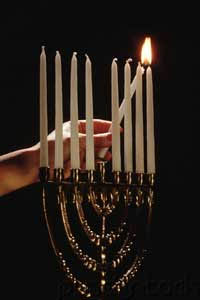
The celebration of the Jewish festival of Chanukah (sometimes written as Hanukkah) remains a mystery to many Bible believers. It begins this year on Friday, December 15, at sundown. Its beginning is on the Jewish Shabat this year. The date is Kislev 25 on the Jewish calendar. It continues for eight days in commemorating the tradition that the oil for the light in the Second Temple (the one built in the time of Haggai and Zechariah – completed in 516 BCE) was sustained so that the Maccabees could finished [sic] their victory over Antiochus Epiphanes and the Seleucid domination of the Holy Land. The Temple was then cleansed from its pagan defilement.

Jewish People give gifts to one another on each day of this celebration, usually beginning with a small item that does not cost a great deal. Each day the gifts increase in value.

The prominent symbol of the celebration of Chanukah is a Menorah with nine branches instead of the seven used for the Temple Menorah (lampstand). The four branches on each side of a central candle (total of eight) represent the eight days that tradition says the light of the Temple was sustained miraculously by the oil. The arguments among Jewish scholars over the significance of the central candle continue to this day, but the prevalent view of rabbinical tradition is that the central candle refers to the light of the Messiah Himself!

That seems to match what we read in the Gospel of John. In John 10:22 we read that our Lord Yeshua was present at this “feast of dedication” in Jerusalem, and it was “winter.” In John 7:2 we know that the events of that chapter were clearly at the time of the “feast of Tabernacles” which comes in the fall in the month of Tishrei (Tishrei 15-22), which is the seventh month o the Jewish calendar. The following month is Cheshvan, and immediately following is the month of Kislev when Chanukah is celebrated. So, the period of time between the events of John 7 and John 10 is approximately 63 days. Some Biblical scholars believe that there is a slight “time gap” between John 7 and John 8, the story of the women taken in adultery. In John 8:12 Yeshua said: “I am the LIGHT of the world: he that followeth Me shall not walk in darkness, but shall have the light of life.” Similar words were spoken by our Lord in John 12:35-36, 46.

In John 8:20 we learn that the words of our Lord Yeshua about being the “LIGHT of the world” were spoken in the “treasury” as He “taught in the temple.” If the occasion was connected with the celebration of Chanukah, then we know that giant candelabras were lit in that area of the Temple during the festival; and all the way from Amman, Jordan, it looked like Jerusalem was on fire (remark in the writings of Flavius Josephus)! It appears from the closing words of John 8, that Yeshua escaped an attempt to stone Him. John 9 is the story of the man born blind who was healed by our Lord. It is possible that the words of John 10 about the Shepherd and His sheep should be connected with the story of John 9. In any case, by John 10:22 we are now at the “feast of dedication (Chanukah).”

This celebration is known as the “festival of lights,” and many scholars believe that all the “lights” associated with the celebration of Christmas actually have their roots in the Jewish festival of Chanukah.

Reprinted from Hope for Today Newletter Volume XI Number 12 - “What is Chanukah” by David Hocking

Tuesday, December 21, 2004

What About the Gospel of Thomas?

Ever since 1999 when the movie Stigmata came out, there has been much controversy over a book known as The Gospel of Thomas. In the movie the Catholic church was portrayed as trying to hide this book by labeling it a heresy because if people found out about its existence chaos would break out. In turn, many people I’ve met have automatically assumed this book is legitimate and accept it as such. So what’s the deal? Does the Gospel of Thomas belong in Bible? If no, than why not? Let’s take a look.

I find it ironic that most, if not all of the people I talk to that defend this book have never read it for themselves. I firmly believe that anyone who actually takes the time to read it will most assuredly come to the conclusion that it has absolutely no business being placed in the Bible. In the interest of fairness, I have provided a link for you to check it out for yourself. To read the actual Gospel of Thomas Click Here. The Gospel is only 114 verses long and can be read in about 10 minutes. I’ll go ahead and wait here until you’re done.

While some are reading the text for themselves, I’ll go ahead and give some background information for those who elected not to. The Gospel of Thomas doesn’t read like a real Biblical Gospel. That is, instead of reading in story-like fashion, it is a collection of Jesus’ alleged sayings. They are then presented independently much like the book of Proverbs. The book is very confusing. It has an eastern philosophical sound to it along with heavy Gnostic concepts. If you don’t know what a Gnostic concept is I’d encourage you to stop here and read my last post (What is Gnosticism? posted on December 16, 2004)

The Gospel of Thomas was found in 1945 at a dig known as Nag Hammadi. The text was found in a collection with other known Gnostic documents. The author of the book is unknown and no Scholar I know of thinks Thomas the disciple actually wrote it. It is important to note that because the book doesn’t list any historical events (such as in a narrative) we cannot independently verify its validity. That is, we cannot prove that the sayings are legitimately from Jesus.

Although we only have fragments of the Gospel of Thomas dating to 200 AD, most Scholars think the book was written between 100 and 150 AD. Seems like quite the coincidence that this time frame occurred during the high point of Gnosticism. The document found at Nag Hammadi is the ONLY complete document we have of the book and it was written in Coptic. This is significant for two reasons. First, the original was most likely written in Greek and secondly, the Nag Hammadi document dates to about 350 AD. So, quickly recapping, we have only one complete document, written 200 hundred years after the original was written, in a language other than the original language, and we have no way to independently verify the historical accuracy of Jesus’ sayings. So far this isn’t looking good for those who advocate the legitimacy of the book but let’s continue on to look at what the text actually says.

True to Gnostic belief in “special knowledge”, the Gospel of Thomas takes several stories found in the Bible and twists them to either add or change components within. For example, in Matthew 22:21 Jesus says “Give to Caesar what is Caesar’s and to God what is God’s.” However, according to the Gospel of Thomas in verse 100 it reads “They showed Jesus a gold coin and said to him, "The Roman emperor's people demand taxes from us." He said to them, "Give the emperor what belongs to the emperor, give God what belongs to God, and give me what is mine.” See how the author of the book completely misses the point Jesus is trying to make, and adds “special knowledge” to extend Jesus’ statement.

The author of the Gospel of Thomas apparently has quite a bit of this special knowledge. In 1st Corinthians 2:9 the Apostle Paul writes “but just as it is written, "Things which eye has not seen and ear has not heard, And which have not entered the heart of man, All that God has prepared for those who love Him." Now compare this with the Gospel of Thomas verse 17 “Jesus said, "I will give you what no eye has seen, what no ear has heard, what no hand has touched, what has not arisen in the human heart." These two passages seem much too similar to be a mere coincidence. So who actually said it? The Apostle Paul, from which we have much evidence, or Jesus as quoted from the Gospel of Thomas from which we have virtually no evidence?

The following is a compilation of just a few of my favorite quotes from the Gospel of Thomas. I have cited their verse references for you to check it out for yourself. Some of these are amusing and others are just downright confusing. Regardless of which, it is important to remember that Jesus always taught in parables, and never in soundbites.


7 Jesus said, "Lucky is the lion that the human will eat, so that the lion becomes human. And foul is the human that the lion will eat, and the lion still will become human."

14 Jesus said to them, "If you fast, you will bring sin upon yourselves, and if you pray, you will be condemned, and if you give to charity, you will harm your spirits…

105 Jesus said, "Whoever knows the father and the mother will be called the child of a whore."

112 Jesus said, "Damn the flesh that depends on the soul. Damn the soul that depends on the flesh."

86 Jesus said, "[Foxes have] their dens and birds have their nests, but human beings have no place to lay down and rest."

And my personal favorite…….


114 Simon Peter said to them, "Make Mary leave us, for females don't deserve life." Jesus said, "Look, I will guide her to make her male, so that she too may become a living spirit resembling you males. For every female who makes herself male will enter the kingdom of Heaven."

As we have seen the Gospel of Thomas is a very different book from any book found in the Bible. As addressed in previous posts the books of the Bible were very carefully put together after passing stringent criteria. The Gospel of Thomas meets none of those criteria. In an effort to grab power, Gnostics put their own spin on Jesus words and recorded them in this text. As stated before, we have only one complete document dating from 200 years after the original was written and it is in a foreign language. As if that weren’t bad enough, we have no way to verify its claims. In conclusion I hope you can clearly see that one can argue that either the New Testament or the Gospel of Thomas or neither of the two accurately depicts the person of Jesus, but one cannot argue that both the New Testament AND the Gospel of Thomas together accurately portray him

Thursday, December 16, 2004

What is Gnosticism?

Gnosticism is a heretical (a teaching contrary to Biblical doctrine) belief system that has been around for quite some time and is still causing problems today. We are surrounded by Gnostic teachings and beliefs on a regular basis (i.e. The Gospel of Thomas) so I think it is important to take a quick look at what Gnosticism is and where you will see it today.

Gnosticism, which comes from the Greek word gnosis, (which means “knowledge,”) became very popular during the second century AD. Gnosticism wasn’t always known by this name. It was originally known as the “Colossian Heresy.” In fact, the Apostle Paul wrote his letter to the Colossians with the sole intent to combat the influence Gnosticism was having on Christians.

At first glance, one could say that Gnosticism appears to be where oriental mysticism meets Greek philosophy. However a more in depth look reveals that instead of being a set of beliefs, Gnosticism tends to be more of a framework for how one view’s the world. Gnosticism in its most basic form attempts to answer two basic questions: “How can evil be explained for God is supreme?” and “What is the relationship between God and matter?” Gnostics believe that they have a special secret knowledge that is hidden from most believers. They believe that the spirit is good, but all flesh, as well as the entire physical world, is evil. They believe that a mutual dualism exists between God and evil. Gnostics are dualists. A dualist is someone who believes that both God and the material world exist, but yet God doesn’t ever intervene or interact with the natural world.

In regards to Jesus Christ, Gnostics deny Christ as both God and Savior. Naturally this indicates that they deny the atonement. They believe Christ only appeared to be a human but yet he wasn’t. This view has some serious ramifications. First and foremost, if they don’t believe in Christ as their savior, how can they get to heaven? Gnostics believe that knowledge of one’s true self and of the character of the universe is the way to salvation. They believe that salvation is achieved when at death the person passes through barriers and is reintegrated with God. Being reintegrated with God tends to have a pantheistic flavor to it. (Pantheism is a belief that God is everything). This utter rejection of Christ will lead to eternal separation from God. (See John 14:6)

Gnosticism is still common today. It is big with new agers as well as those in mind science cults, such as Christian Science. (For example, Mary Baker Eddy, the founder of Christian Science, writes “Jesus is the human man and Christ is the divine idea. Jesus is not the Christ but the highest human corporeal concept.”) Can you see the elements of Gnosticism we discussed above as being present in Mary Baker Eddy’s statement?

Some people have even formed a Gnostic Church. I don’t know much about this church other than on one hand they use church saints, the church calendar, and the Bible, yet on the other hand they use Gnostic Scriptures (i.e. the Gospel of Thomas), Catechisms, and readings. You can check out the Gnostic Church’s website at http://gnosis.org/.

In my next posting, I will be dealing with perhaps the most popular Gnostic doctrine out right now, The Gospel of Thomas.

Thursday, December 09, 2004

Wasn’t Christmas Originally Celebrated as a Pagan Holiday?

I thought that in the spirit of the season I would address a question that seems to come up every year. That is, did Christmas originate as a Pagan holiday? The surprising answer is that although it coincided with pagan festivals that were occurring at around the same time, Christmas itself did not originate from a pagan holiday. (In fact, the word “Christmas” comes from two other words meaning “Christ” and “Maesse” or “mass” which means “The Mass of the Christ.” It is so named because it is in reference to when the Catholic priest re-offers the sacrifice of Christ on the Cross). In order to more fully understand this, we must take a quick look at history.

There are stories of many cultures with celebrations ushering in the winter season. In the Roman Empire, Saturn (the god of sowing) was worshipped in a celebration called “Saturnalia.” This celebration marked the winter solstice and its date varied every year (but it usually occurred between December 17th and 23rd). Now the exact reasoning varies depending on what research you’ve done. Some sources say the church wanted to get rid of the Pagan worship but was having difficulty. Other sources say the Christians wanted to move their celebration of the Lord’s birth (which was already being celebrated in the springtime) to this time to provide a contrast for the Pagan worship. That is it would provide an alternative for Pagan worship as well as help protect Christians that were being wooed into these celebrations. (Similar to what many missionaries do today). Either way, what is agreed upon is that the Roman church wanted to adopt the holiday, they turned it into a celebration of the Lord’s birth, originally called it the “Feast of the Nativity” and it has been a part of western culture ever since.

Many people claim that the celebration is misleading because nobody knows the exact day Jesus was born. I don’t know about it being misleading, but they are absolutely correct about Jesus’ actual birthday. While some Scholars estimate it could have been in April or October or September, no one knows for sure. And that is okay. It’s no different than throwing a belated birthday party for someone whom was out of town. It’s the meaning of the celebration that provides its value, not its accuracy on a calendar. (Considering that our calendar is off by 4 years anyway [i.e. Jesus was actually born in 4 BC] it shouldn’t really matter).

In regards to whether or not Christians should celebrate Christmas I really don’t want to go into because I don’t see it as being an issue important enough to possibly upset someone. Different people have different opinions on the issue and that’s fine. I will say this though; it is the worshipping of Jesus that makes the day holy and not the potential pagan origins that makes the day evil. I see nothing wrong with re-inventing cultural practices with a spiritual meaning; after all God did it. I bet you didn’t know that long before God instituted circumcision as a ritual among the Jews it was being practiced by the Egyptians. To the Egyptians it was a cultural practice. When God gave it to the Jews he gave it to them with spiritual implications. In addition to that, God gave the Jews many different festivals and celebrations throughout the year as opportunities to worship and remember what God did for them.

Whether or not a Christian should celebrate Christmas is a personal choice. For reasons mentioned above, I personally have no problems celebrating Christmas as I focus on the birth of my Savior and not anything else anyone associates with it. If you don’t believe in celebrating Christmas that is definitely your choice, however I have found a well written article that may impact your decision. Click HERE to read it.