''We will try to see if he converts to Islam, for Islam is the religion of compassion. But if he does not, Islamic law will be enforced,''
- Afghanistan Supreme Court Judge Ansarullah Mawlavizada in reference to the trial of Afghan Abdur Rahman who faces the death penalty for converting from Islam to Christianity.
Thursday, March 23, 2006


Monday, March 20, 2006
Food For Thought
I recently received a letter from Voice of the Martyrs an organization that works to meet the needs of persecuted Christians all over the world. The following is an excerpt from that letter and I think it raises a good question about the nature of who Jesus was in comparison to Mohammed.
“Last week I read an article that you may see in a future newsletter. The Christian writer was talking about the violent Muslim riots resulting from the cartoon of Mohammed with a bomb in his turban. Mohammed was a warrior and violently killed many for Islam. The writer muses that if someone drew a cartoon of Jesus with a turban, what would they put in it? A fish? A loaf of bread or the name of a hospital or orphanage? This is an interesting thought to ponder…We at VOM are thankful for dedicated readers who realize that the bread and fish, along with the gospel are more powerful than any bomb.”
“Last week I read an article that you may see in a future newsletter. The Christian writer was talking about the violent Muslim riots resulting from the cartoon of Mohammed with a bomb in his turban. Mohammed was a warrior and violently killed many for Islam. The writer muses that if someone drew a cartoon of Jesus with a turban, what would they put in it? A fish? A loaf of bread or the name of a hospital or orphanage? This is an interesting thought to ponder…We at VOM are thankful for dedicated readers who realize that the bread and fish, along with the gospel are more powerful than any bomb.”
Wednesday, March 15, 2006
Back From Cambodia
I know it has been a few days since I posted. After Indonesia I headed towards Cambodia and there isn't a whole lot of internet access over there. Now I'm home and thought I'd post some pictures from my time there.
This is part of the wall of skulls.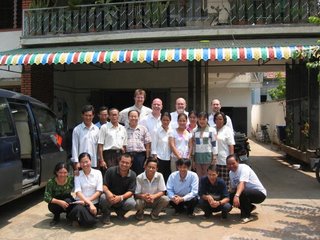
This is a photograph of the Cambodian nationals who work day and night to minister to those dying of AIDS. Some work inside of the building behind us which is used as a hospice while others go out into the community and make house visits. The sacrifice these individuals make in order to make sure that everyone has an opportunity to learn about Jesus, is incredible.
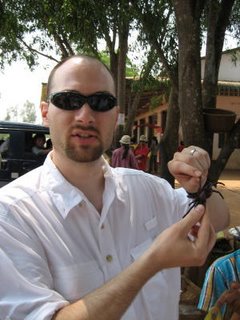
Part of my time in Cambodia was spent eating ethnic food such as this tarantula. Whoever said a life of serving God was boring???

Cambodians love Americans but not for the reasons you might think. Cambodians are predominately Buddhist (about 95% of them). Because of this they have an interesting view of Americans. They believe Americans are wealthy and blessed and in the context of their Buddhist worldview, that must mean we are good people. On our path towards enlightenment we must have been good people in our past life because we are now being rewarded in this life (the reward being wealth, life in America, freedom to travel, etc.).

This is a common form of transportation in Cambodia

The kids in Cambodia are just like the kids I've met in Romania, Indonesia and South Africa. They are joyful and full of love. We as adults, while good intentioned, tend to look past them as human beings loved by God and instead focus on their level of poverty. In my experience children don't see it quite that way. They don't care about the color of your skin or what your salary is. They just love to play and have fun with you.

While in Cambodia I had an opportunity to visit Tuol Sleng. This photo is a picture of thousands of mugshots of the victims lined up throughout the grounds. Here is an excerpt from my journal about my time there...
"Tuol Sleng is the Cambodian version of Auschwitz. It used to be a high school before the Khmer Rouge took it over and turned it into a place to torture people them and then kill them. The people they brought here weren’t criminals. They were priests, teachers, artists, professors; people of skills. The Khmer Rouge wanted to remove these people from society to start afresh. It was so horrible that my eyes tear up just writing this. Historians kept the prison as they found it in order to preserve it as a historical monument so the atrocities of the Khmer Rouge would never be forgotten. As such there are still instruments of torture lying around, blood stains on the ground, and a wall of skulls belonging to victims. A sign at Tuol Sleng told us that of the 20,000 people imprisoned here, only 7 survived. Only 7! Touring Tuol Sleng there are hundreds of “mug shots” of the prisoners who were there. Many of them were children. As I walked up and down the walls of photos I wondered how many children died without ever having had a chance to hear the gospel? Walking throughout the place I tried to tune into my discernment of spirits gift. I felt the place to be a giant vacuum. Completely empty. To have this much evil is beyond human ability alone. There is no doubt demons were involved. Now that their work is done here I feel they have completely left this place, like a soul leaves its corpse behind."

This is part of the wall of skulls.

Tom and I went on a home visit to spend time with this family. Two of the members of this family have AIDS. They live in a squatter home (a makeshift home made of spare parts lying around) behind a shopping area. We took some photos of them and then went to a one hour photo store to have them developed. Here you see Tom presenting those photos as a gift to the family. This family had no photographs of any of their family members. It was a blessing to be able to provide them this small gift.
In Cambodia a common belief is “wives are for childbearing, prostitutes are for pleasure.” This plays out in that often a man will visit a prostitute, get AIDS, then come home and give it to his wife. Most often the man will die first leaving the woman behind to care for the family. After the man dies the woman must support her family so she often turns to prostitution herself, continuing the cycle.
This little boy, Chantol is 7 years old and he has AIDS. His father died from the disease. His mother is infected. He lives in the house in a squatter community on the Mekong, in the interior of Cambodia.

Some of the staff with the organization I work for, run a place where women with AIDS can come to make crafts to earn an income instead of turning to prostitution. Here we are praying with some of these women.

This is a photograph of the Cambodian nationals who work day and night to minister to those dying of AIDS. Some work inside of the building behind us which is used as a hospice while others go out into the community and make house visits. The sacrifice these individuals make in order to make sure that everyone has an opportunity to learn about Jesus, is incredible.
Part of my time in Cambodia was spent eating ethnic food such as this tarantula. Whoever said a life of serving God was boring???
Saturday, March 04, 2006
Muslim Call to Prayer Video
This is a short video taken in Indonesia of a Muslim call to prayer. Muslims pray 5 times a day and this was the afternoon call to prayer. Like most Muslim areas in the world, you can hear the call throughout the entire city. The mosque is the tall statue in the background.
<---To view the video click on the picture.
The video is pretty short but it is in a Windows Media Player format. For those using Windows there shouldn't be any problem with the playback, but for for those of you with a Mac, if you haven't already, you'll need to download the Windows Media Player for Mac. You can do that by CLICKING HERE.
Heading South into Indonesia
I recently had an opportunity to spend some time with some missionaries down in Indonesia. Due to security reasons I can't tell you exactly who, where, or what (I'm sure you can understand why). However I can tell you that some exciting things are going on down there. God is doing tons and people are coming to Christ. I heard several stories of miraculous events taking place. Please keep Indonesia in your prayers. I wanted to share a few photos with you. These photos were taken in a little village off the side of a main road. Long story short, there is a very good chance that we were the first white people that ever stepped foot into their village. To show that we not only viewed them as human beings but that we wanted to be with them in their own village meant so much to them.
I'll let the pictures speak for themselves...


I'll let the pictures speak for themselves...


Photos From Singapore




Thursday, March 02, 2006
Greetings From Singapore
You may have noticed that I haven’t posted in a while. Well that’s because I’ve been in Singapore the past few days. I’m in Singapore as part of a 3 country trip to work in various ministry contexts. I had a break in my work and thought I’d take a minute to give you some of my initial impressions of the city.
Singapore is very clean and very disciplined, which is what you’d imagine from the wealthiest (per capita) nation in Asia. Being about 1 degree above the equator means its hot and humid but most places have air conditioning inside. Singapore has a unique blend of urban setting and lush tropical greenery.
The country is mostly Chinese, Malay and Indian. (The country even has both a Chinatown and Little India). As such, Singapore is a strategic location for nationals to reach those in places like China and other restricted countries, that Westerners either don’t have access to or won’t have the same success as a national.
So, because of that, right now I’m working with about 80 different pastors who represent 25 people groups. Some of them work with local congregations while others work in a missions capacity. So far the only real obstacle was getting stuck in an elevator but the week is still young. I’d greatly appreciate your prayers and will try to post some pictures soon.
Saturday, February 25, 2006
What does it look like to be a Christian in South Korea?

The long awaited video is finally here. Well it may not exactly be long awaited but it has taken me tons of hours to get it up and running. (If you have problems viewing it, please either email me or leave a comment so I can try to fix it).
This is a video hodgepodge of still pictures, audio and video I created from the time I spent in South Korea. Most of it is taken from the pastors conference I mentioned in my last post. To watch the video just click on the picture.
The video is just under 2 minutes in length but it is in a Windows Media Player format. For those using Windows there shouldn't be any problem with the playback, but for for those of you with a Mac, if you haven't already, you'll need to download the Windows Media Player for Mac. You can do that by CLICKING HERE.
Wednesday, February 22, 2006
Reflections from my time in South Korea
Last December I was in South Korea. (I know, South Korea in December, can you say freezing?). Well I braved the cold to spend 8 days working with over 60 Korean pastors from all different denominations to help them develop healthy churches.
I found it interesting to learn that approximately 25% of the entire South Korean population are church attending Christians (mostly Presbyterian), yet Korean churches are also experiencing the same problems as American churches, especially in trying to retain the younger post-high school, pre-college age group.
I spent some time working with the new CRM Korea Board of Directors and helping them get established. One of CRM’s core values (CRM is the mission agency I work with) is to raise up nationals to lead the work in their home country and then send out other nationals as missionaries into new countries. So not only is all of our work in South Korea led by South Koreans but they just sent their first missionary into another country.
I wanted to share two quick thoughts with you. These are excerpts from my journal that I wrote while in South Korea:
Tonight while driving through Seoul I looked up at the skyline and noticed there were crosses everywhere. As far as the eye could see there were red, illuminated crosses. It was clear for all to see, there was a heavy Christian presence here in the nation’s capitol. I then realized that just a mere 30 miles to the north [Into North Korea], being known as a Christian or even revealing a cross, could warrant an instant execution. At that moment a wave of sorrow for my brothers and sisters in the north consumed me. I can’t remember feeling anything like it before.
One of the highlights of this trip is to pray and worship with the Koreans. When Koreans pray, it is very powerful, loud and authoritative. Even without knowing the words being spoken, one can almost comprehend the requests based on the passion and power behind them. Interestingly enough, this is also how Koreans sing. They sing at the top of their lungs and with authority. No one stands there wandering if the person next to them will think they are a good singer. It is totally and completely focused on worshiping God. No distractions. I wish more church congregations in America sang this way.
In my next post I'll try to put up some video from South Korea.
Sunday, February 19, 2006
New Articles Added
Just wanted to point out that I've added four new articles to the "Articles I've Written" section. These articles were written while I was working on my Master's degree.
Friday, February 17, 2006
A Whole New Look
It's alive, It's alive !! Okay, well the site has been alive for over a year now so I shouldn't be too dramatic but I am excited about all the new changes. I'm sure you've noticed the site has a whole new look. Gone is the lighthouse, white background and script, I now have a new template to work with and I think it looks a lot better.
In addition to a new look there are several new feature changes that have been made, and many more that are forthcoming. Since some of them are subtle, I'll take a minute to point them out.
First, I have a picture up. Those of you who don't know me can probably tell why I didn't have a picture up before and all of you who disagree with what I write about can now have something for your WANTED posters.
Second, I formatted the archives into a drop down box so you don't have to do a tremendous amount of scrolling.
Third, at the bottom of the section entitled "My Favorite Places" I now have a link for you to email me, as well as a means for syndication (syndication deals with RSS readers, not newspapers for publishing). Now, I am rather technically challenged so I don't exactly know the details of how syndication works with RSS readers. I think I got it down but if you are using an RSS reader and it's not working, let me know and I'll see what I can do.
Fourth, I now have all my posts listed by title on the side so you can scroll down a short list instead of the whole blog. They look like links but as of now they won't take you to a page. I'm trying to figure out how to make them work, if you know what I need to do, please let me know.
Fifth, I decided to tryout the idea of enabling comments. We'll see how well this works as it's new for me.
But that's not why I'm excited. I'm excited because I finally found an external server in which I can upload files to. This means a whole new world for my site. I can not only upload pictures (to make it no longer just dull text) but videos and articles I've written. (Check out the section entitled Articles I've Written. Right now there is only one but there are many more on the way.)
This should make the site much more visually stimulating. There is one more change though that I am making; the change of content. I will continue to post about apologetic issues, especially contemporary apologetic issues, however I want to branch out into other areas. Specifically the area of missions.
As a missionary I have an opportunity to work with Christians from all over the world. I ususally take many pictures and videos while I'm working with them. I realize that many of you will never have a chance to experience what it's like to be a follower of Jesus outside of the United States (or your home country). So I'd like to begin posting some of these photos and videos so that you will be able to gain a better understanding of life for other Christians.
Having this new content will enable me to begin to post on a more frequent basis. It used to take hours for me to develop the content of my previous posts. This new content will go much faster.
I definitely value your feedback about these new changes. Please let me know what you think.
Monday, February 06, 2006
An Apology
Dear Readers,
I owe you an apology and a bit of an explaination. As you probably noticed my last posting was the end of September 2005, nearly 5 months ago. Many of you have told me you thought I dropped off the face of the earth. Well I haven't. Unfortunately planning a wedding consumed way more of my time that I expected it would and as such, my blog was among the first of many time consuming activities to be cut. For that I am sorry.
Well the wedding is finished as well as the subsequent honeymoon and receptions (yes plural) and life is ready to begin again. I'm planning to begin blogging again very soon (as in the next week or two). I am wrestling with some format changes. I've been thinking that while I'd like the format to continue to focus heavily on contemporary apologetics in the real world, I'd like it to expand to cover other areas as well.
Since I am blessed to be able to go all over the world and work with Christians in many different countries and cultures I've experienced quite a bit about the "bigger picture." So often we in America think we know exactly what God is doing in the world and the more I travel to meet with other Christians, the more I realize God's plans are so much bigger than we think.
Enough.
As I was saying I'm still deciding on these format changes and would be very interested in your thoughts and comments. You can send me an email at RemovingDoubtsATaolDOTcom.
Friday, September 23, 2005
Humans Are No Different Than Apes?
This seems to be the case according to the London zoo. I read an article a few weeks ago that said the London zoo was now putting human beings on display. (You can read the article and see pictures for yourself by CLICKING HERE).
As I read through this article several thoughts popped into my mind. The first was, “Are you serious?”
According to the zoo, the purpose of this display is to show that humans are no different than animals. Rather we are simply primates like an ordinary monkey. Polly Wills, the spokeswoman for the zoo, said “Seeing people in a different environment, among other animals…teaches members of the public that the human is just another primate [emphasis mine].”
Just another primate? How many other primates use the telephone on a daily basis? How many other primates invented mass entertainment like television and movies? How many other primates invented methods of transportation allowing them to visit their primate relatives anywhere else in the world in less than 24 hours? How many other primates have put their species on the moon AND the depths of the ocean? Seems to me that at the very least our accomplishments and lifestyle should put us into a whole other category which brings me to my next point.
Aren’t classifications like “primate” and “species” a human invention? Sure there are types of animals that may look similar to the eye, but there is no law that nature imposed on itself in regards to classifications. Prior to scientists developing this classification system there was nothing like it in nature. So to say that humans are just another primate seems kind of pointless. Classifications change and many scientists disagree on certain animals belonging with other animals in the same category.
Perhaps most of all I was surprised by the inconsistencies in the zoo administration’s actions and beliefs. For example, these humans on display are wearing bathing suits with fig leaves on them. My question is why? If we are just another primate shouldn’t we be in the nude as that is our natural state? To put humans in bathing suits is like putting a blanket around the elephant, it isn’t found in nature. I would presume that zoo officials would argue they are wearing clothes so as not to offend anyone. Offend another member of the same species by appearing in our natural state? Hmmm, that’s interesting as I can’t think of a single other animal that does that. Could it be because we have morals and values which are ALSO something that no other species has? How can we be “just another primate” if we are the only ones with morals and values?
My second question is why are the humans allowed to go home at night? Why don’t we just walk down the street, kidnap a few humans and through them in and lock away the key? No other animals get to go home at night. It’s because we have certain values and rights (like respecting life and freedom) which we grant to each other. No other animal does this. So how can we be observing humans as “just another primate” if we have created all of these unnatural stipulations?
For my final thought I find it fascinating that humans in the zoo are covered by fig leaves. Why fig leaves? The only answer that makes sense to me is that it’s taken from the story in Genesis chapter 3. (In Genesis 2:25 we find Adam and Eve, the first man and woman, were naked and felt no shame. After being tempted to, and subsequently, rebelling against God, Adam and Eve “…realized they were naked, so they sewed fig leaves together and made coverings for themselves.” [Genesis 3:7])
But this is peculiar because the zoo officials seem to not have much difficulty taking that part of the story out but they sure don’t buy into the part about God creating man. Seems to me that isn’t very intellectually honest; but that’s a post for another time.
In conclusion, I’d like to leave you with the words from Almighty God himself on how He feels about humans, and let you decide on your own if, as the London zoo advocates, we’re “just another primate.”
Then God said, "Let us make man in our image, in our likeness, and let them rule over the fish of the sea and the birds of the air, over the livestock, over all the earth, and over all the creatures that move along the ground." So God created man in his own image, in the image of God he created him; male and female he created them. God blessed them and said to them, "Be fruitful and increase in number; fill the earth and subdue it. Rule over the fish of the sea and the birds of the air and over every living creature that moves on the ground." Then God said, "I give you every seed-bearing plant on the face of the whole earth and every tree that has fruit with seed in it. They will be yours for food. And to all the beasts of the earth and all the birds of the air and all the creatures that move on the ground-- everything that has the breath of life in it-- I give every green plant for food." And it was so.
-- Genesis 1:26-30
-- Genesis 1:26-30
Tuesday, August 09, 2005
Quick Thought
With the postmodern generation/mindset among us, it feels like there has been an influx of criticism towards different evangelistic methodologies (i.e. Evangelism Explosion, 4 Spiritual Laws, Bridge Diagram, Evangelistic Crusades, etc.). It seems that almost everyone I talk to has a very strong opinion about which methods don't work and why they should be abandoned. I find this most ironic as the very generation/mindset that wants to paint everyone as an individual and not generic, in the same breath feels that different evangelistic methods, although not their particular "cup of tea" must not be able to work for anyone else.
I came across this story in an article I read recently and thought that it captured my feelings perfectly (especially when I realize that the conversation must have happened over 100 years ago):
I came across this story in an article I read recently and thought that it captured my feelings perfectly (especially when I realize that the conversation must have happened over 100 years ago):
The story goes that on one occasion D.L. Moody [1839-1899] was criticized for his mass evangelism methods, and he replied to his critic, "I don't like them either. What methods do you use?" When the critic indicated that he didn't use any evangelistic tools or activities, Moody said, "Well, I like the way I do it better than the way you don't." We should keep that in mind, especially when we encounter evangelism practices that make us cringe
Wednesday, July 20, 2005
Conclusion to the Series on Intelligent Design
Recent support for the Intelligent Design movement has caused a major wave in scientific communities. Historically Darwinists could write off those that support Intelligent Design as ignorant religious fundamentalists. However a new understanding of the differences between Intelligent Design and Creationism has driven a wedge into their argument. Although Intelligent Design does claim to find substantial evidence in the world for a designer, Intelligent Design does not claim to have knowledge about that designer nor does it seek it.
Intelligent Design has forced many in the scientific community to realize that there is a difference between philosophical assertions and scientific ones. For example, a true Darwinist cannot look at something in the world and say it is “bad.” For that would either be contrary to the “natural selection” viewpoint or it would pre-suppose a designer who made a mistake. Either way it would be a philosophical observation and not a scientific one. It is important for academic integrity for philosophy to remain philosophy and science to remain science.
Intelligent Design has also shown many that its foundational concepts are used in everyday life and accepted without challenge. Crime Scene Investigators, Archeologists, Military Cryptographers and many more use Intelligent Design to help them with their tasks all the time. Yet when these same proven and trusted precepts are moved over to the biological realm, a huge uproar occurs. Intelligent Design has shown that many people are ignorantly living in an inconsistent worldview.
Intelligent Design has brought to the surface several hypocrisies in the scientific community. Scientists are trying to have the best of both worlds when they exclude Intelligent Design when trying to explain origin of life but embrace it when they need to figure out whether something is a worthless rock or priceless artifact. Intelligent Design has also forced the scientific community to reveal its ugly side. As more and more overwhelming evidence for Intelligent Design becomes apparent, more and more of the arguments against it turn to smear campaigns against the person’s character rather than against the theory itself.
In the past few years the Intelligent Design movement has gained massive momentum. More and more top scientists are beginning to study the concepts Intelligent Design utilizes and are beginning to realize the truth behind it. History has shown that there is a pendulum of public opinion that sways back and forth. Since 1859 the pendulum has been swinging towards the theory that evolution contains the answers to the origin of life. However, with the recent developments in Intelligent Design, I believe that pendulum has clearly reached its apex and is rapidly swinging the other direction.
Thank you for taking the time to bear with me through this series. I realized Intelligent Design is not an easy topic to understand and you may be even more confused than when you started. But I hope you have learned a few things and realize that when held to the same standard of other sciences, biology must at least look at Intelligent Design theory as a possibility until evolution moves from a theory to a scientific law.
Thursday, July 14, 2005
Is Intelligent Design Used Today?
In our last post I briefly mentioned the concept of consistency. Today I want to look at examples of Intelligent Design being not only used, but widely accepted in a wide variety of disciplines in today’s world. As we take this quick journey I hope you can quickly see that opponents of Intelligent Design are …….
The concepts behind Intelligent Design are used today in many different disciplines of science. In fact, many different fields of science would not be able to function or even exist without some form of acceptance of Intelligent Design.
For example, a Crime Scene Investigator uses Intelligent Design when he approaches a crime scene and has to determine whether a person died as an accident or the result of foul play.
If an Archeologist finds a weird shaped rock he must determine if it is the result of abnormal weathering or if it was chipped that way by a pre-historic hunter.
A Military Cryptographer must decide if a piece of paper handed to him with jumbled letters is just a random sequence or the enemy’s secret code. All three of these disciplines use precepts, such as specified complexity, found in Intelligent Design.
Naturalists claim that we must have solid natural explanations to work with. Eugenie Scott in her essay entitled The Nature of Change (Click Here to read the article), wrote “…but even if we didn’t [have solid explanations to work with], science only has tools for explaining things in terms of natural causation.”
Again we are faced with an incompatible situation. Scott is claiming that science can only explain things in terms of natural causation. This is true if, and only if, the person establishing scientific guidelines decides to incorporate it. In and of itself there is no reason natural causation has to be a criterion. In fact, it seems quite suspicious that it would be there in the first place. The only logical reason would be to ensure that it could exclude any theory that relies on something that mere human reasoning cannot explain. Again we are faced with the scientific community not actually being interested in the truth, but what fits with their agenda.
Another point to consider is that if Intelligent Design is well received in certain scientific fields but not others, serious problems begin to arise. As seekers of truth and academic integrity we must begin to ask questions about this. For example, how can we trust the Archeologist or Crime Scene Investigator if the objective methods used are only true for his field and not others? Wouldn’t truth be truth regardless as otherwise it would be relative?
Phillip Johnson raises a great question when he asks “If design is a legitimate subject for scientific investigation in the case of computers, communications from space aliens, and peculiar markings on cave walls, why should it be arbitrarily excluded from consideration when dealing with the biological cell or the conscious mind?” We must hold those in the scientific community accountable for hypocritical practices.
I hope you can see that those opposed to Intelligent Design theory really aren’t opposed to the theory in any field whatsoever, except biology. When one becomes opposed to a theory based on personal preferences instead of pursuit of truth regardless of where it leads, we no longer have science, we have chaos.
Friday, July 08, 2005
Arguments against Intelligent Design
Okay, so now we (hopefully) have a basic understanding of what Intelligent Design is. However not everyone believes in this theory. I want to take a moment and look at some of the more common objections that are out there.
One of the biggest problems opponents of Intelligent Design face is that of not mixing scientific assertions with philosophical or religious ones. True science requires a neutral mind open to all possibilities in the pursuit of truth. Yet most naturalists assert that Intelligent Design has no place in science academia and should be kept to religious circles.
Phillip Johnson wrote in Signs of Intelligence:
“Scientific materialists think that advocates of Intelligent Design are either irrational or dishonest because they are advocating as science a proposition that ought to be confined to religion, namely the claim that scientific evidence points to the reality of a designing intelligence in the origin and development of life.”
But how can science honestly say it is pursuing truth if it already has preconceived stipulations set in place?
For example, Robert T. Pennock states in his essay Mystery Science Theater that:
“The origin of species once seemed equally mysterious, but Darwin followed the clues given in nature to solve that mystery. One may, of course, retain religious faith in a designer who transcends natural processes, but there is no way to dust for his fingerprints.”
Here we can already clearly see that Pennock has closed his mind to a creator God simply because he can’t see evidence of it that is up to his standard. In other words, “dusting for fingerprints” would have to fit his own subjective criteria of evidence as opposed to another person’s criterion where the intricacies of ecosystems or complexities of plate tectonics could suffice.
Dembski has a great retort to this problem. In The Design Revolution he says:
“So long as intelligent design has a demonstrable secular purpose – advancing science, enriching the science curriculum, preventing viewpoint discrimination, promoting academic freedom – its motivation even if religious is legally irrelevant.”
Another problem facing opponents of Intelligent Design is that they are acting inconsistently with their worldview. They claim that they will not accept Intelligent Design as a legitimate theory because it has religious suppositions behind it. Yet those in science and academia conceptually accept and even use Intelligent Design in their everyday lives. Although the next post will specifically focus on these areas, I want to bring up one example here.
This is an example Phillip Johnson gives in his chapter of Signs of Intelligence; “If they [science academia that currently reject Intelligent Design] were to receive a signal containing a sequence of prime numbers as portrayed in the movie Contact, they would conclude it came from intelligent beings – without the need for independent evidence of the existence and nature of aliens.”
Here you can see an example of where the scientific community would be stuck between a rock and a hard place. The evidence would clearly show signs of intelligent life, yet the method used to assert this is the very method they deny as religiously based.
Robert Pennock addresses this issue in his essay Mystery Science Theater. (Click Here to read the article). Here he brings up the very issue of the movie Contact and claims:
"…a design inference like that in the movie Contact, for instance, would rely on background knowledge about the nature of radio signals and other natural processes, together with the assumption that a sequence of prime numbers is the kind of pattern another scientist might choose to send as a signal. But the odd sequences found within DNA are quite unlike a series of prime numbers."
But Pennock is mistaken. He is so focused on the specifics involved with the radio signals, that he completely misses the concept being represented; namely that it is possible to make an inference of something you don’t know about from something that you do know about.
Okay, my guess is by now your head is spinning, I know mine is, let’s call it a day and come back later for an analysis of Intelligent Design in use today.
Tuesday, July 05, 2005
Intelligent Design is not Creationism
One of the ACLU’s biggest arguments is that Intelligent Design is just hidden Creationism. However, Intelligent Design and Creationism are not the same thing!
According to Webster’s New World Dictionary, Creationism is “the doctrine that ascribes the origin of matter, species, etc. to acts of creation by God.” This differs from Intelligent Design in that Intelligent Design only looks for a designing intelligence, and not for information about the designing intelligence. In fact we could be living in a world designed by Martians and as long as it was designed by the Martians this would be totally consistent with the theory of Intelligent Design.
Perhaps William Dembski said it best when he wrote “Creation is always about the source of being of the world. Intelligent Design is about arrangements of preexisting materials that point to a designing intelligence. Creation and Intelligent Design are therefore quite different. One can have creation without Intelligent Design and intelligent design without creation.” (The Design Revolution, 38)
Some people will argue that Intelligent Design is just disguised theology but if they really understand the theory they will realize that it is not. Although it is similar to Creationism in that it has theological implications, it differs in that it does not require specifically theological, biblical presuppositions (i.e. earth created in a day). In fact, even if the Intelligent Design of some structure has been established, it is still a separate question whether a wise, powerful and beneficent God ought to have designed a complex information structure one way or another. (Signs of Intelligence, 10)
Intelligent Design is not concerned with why the designer decided to do something one way and not the other, it is not concerned with what the designer was thinking at the time, and it is not concerned with who the designer is/was. Intelligent Design is only concerned with the fact that there is a designer.
This difference between Intelligent Design and Creationism seems to be a difficult concept to grasp for many Darwinists. For reasons unknown, many seem to attack the individual supporting Intelligent Design instead of attacking the theory of Intelligent Design itself. If you are like me, you may have experienced this yourself.
It seems that because many who support Intelligent Design also happen to be Christians (even though Christianity and Intelligent Design do not have to correlate) makes for an easy target on religious grounds.
For example, Barbara Forrest, a philosophy professor at Southern Louisiana University, wrote a paper titled The Newest Evolution of Creationism. In this paper she states her views on the Intelligent Design movement. The following are some quotes from that paper: (It should be noted that Wells and Johnson are well known supporters of the Intelligent Design movement).
[Jonathan] Wells, influenced in part by Unification Church leader Sun Myung Moon, earned Ph.D.'s in religious studies and biology specifically "to devote my life to destroying Darwinism.”
[Phillip] Johnson, a law professor, whose religious conversion catalyzed his antievolution efforts…
At heart, ID proponents are not motivated to improve science but to transform it into a theistic enterprise.
Note that none of these statements have anything to do with the suppositions set forth by Intelligent Design, but have everything to do with the person that supports it. The quotes listed above are not selected at random but rather give a complete picture as to the nature of the essay. (Click Here to read the article) It is sad to see that those who are considered professionals in their field struggling so badly to find faults with the theory that they are reduced to avoiding it altogether and simply attacking the person.
I hope you’ve been able to see that Intelligent Design theory, although compatible with Creationism, is NOT a requirement for, nor is it a component of creationism.
Friday, July 01, 2005
What is Intelligent Design?
Seems like we should probably start out by defining exactly what Intelligent Design is. According to William Dembski (perhaps the world’s leading scholar in the field of Intelligent Design), Intelligent Design is the name given to a theory of science that states “there are natural systems that cannot be adequately explained in terms of undirected natural forces and that exhibit features which in any other circumstance we would attribute to intelligence.” (William Dembski’s The Design Revolution, page 27).
Now Intelligent Design uses several factors including specified complexity (independent improbable patterns [more on this later]) and irreducible complexity (organisms that cannot be broken down into smaller functioning organisms like some kinds of bacteria) as proof of its existence.
But it is important to define what we mean by the word “intelligent.” According to the book Signs of Intelligence (by Dembski and Kushiner), the intelligent design community understands “intelligent” to refer to “an intelligent agency, irrespective of skill or mastery.”
Confused yet? I hope not, but I had to get that out of the way to set up our foundation.
Intelligent Design is the antithesis of Darwinism. Darwinism, also known as Naturalism, states that the natural world is all there is. It believes the world is exclusively explained in natural terms. Darwinism states that factors such as natural selection and random variation account for life on the planet. When a naturalist (it should be noted that naturalist and Darwinist are interchangeable for this series of posts) talks about science, he will speak from the perspective that the natural world is all there is.
This perspective is contrary to one who subscribes to Intelligent Design. A supporter of Intelligent Design would feel that the results of an intelligent agency can be detected empirically and that the natural world bears evidence of intelligent agency. They would also likely say that naturalism is not only bad philosophy but bad science (we’ll look at this more in depth later).
When dealing with Intelligent Design there are two important facts to keep in mind. First, Intelligent Design is not creationism. I will go into more details later but let me state that Intelligent Design does not account for who designed the world, only that it was designed. In other words, Intelligent Design does not require a belief in God.
Secondly, from a Christian perspective, it is important to remember that Intelligent Design is not an apologetic. Although it does have implications for use in apologetics, it is more pre-evangelistic in nature. (Kind of hard to use it to defend God’s existence if it doesn’t require God’s existence eh?)
Okay, I think that’s good enough for a brief introduction to our topic. I think that this post will be the most complicated of all of them because it sets the foundation. I would recommend re-reading it a few times if you are still confused.
Wednesday, June 29, 2005
Introduction to Intelligent Design
Parents listen up. If you have children in the United States public school system, these next few posts will be very important to you. As the debate over evolution becomes more and more common in our court system, you need to be armed with a basic understanding of the issues.
Earlier this week I read a news article entitled Pennsylvania Lawmakers Debate Evolution in Schools. The article went on to explain that there was a big debate over whether or not to allow “Intelligent Design” theory in public schools before a federal court. Definitely not uncommon. However, having studied this concept at the Master’s level, I was more than interested to read the article.
Predictably, I was saddened at the lack of understanding of Intelligent Design theory, especially by such a large group of educated people.
As such, I’ve decided to do a series on Intelligent Design. As you can imagine ID can be a pretty complex topic so my goal is to break it down into bite sized pieces that make sense.
I want to look at topics like: What is Intelligent Design? Is Intelligent Design really just hidden creationism? Is it in use anywhere today?
Now I’ll be upfront, the purpose of this series is NOT to defeat Darwinism or evolution; nor is it designed to explain Specified Complexity. Those are a topics better suited to a different series at some point in the future. The purpose of this series is simply to help make the theory of Intelligent Design a little more understandable. As always, I’ll do my best to quote from reputable Scholars so you have a chance to research what I have stated, on your own.
As you go through the series and learn more about what Intelligent Design is and is not, I’d like you to keep in mind the following quote from the article as it shows a very common attitude from the ACLU towards the theory of Intelligent Design”
“’How many new biotechnology companies will want to locate here in Pennsylvania if our students are being taught a watered-down version of the complexities of evolution?’ asked Larry Frankel, legislative director for the state’s ACLU chapter”
If you would like to read the article in its entirety, Click Here
Sunday, June 26, 2005
The Great Omission
I was reading a book by Robertson McQuilkin (I know, what a name) called The Great Omission. The following story is taken from that book. I thought it was pretty thought provoking and wanted to share it with you.
In a dream I found myself on an island – Sheep Island. Across the island sheep were scattered and lost. Soon I learned that a forest fire was sweeping across from the opposite side. It seemed that all were doomed to destruction unless there were some way of escape. Although there were many unofficial maps, I had a copy of the official map and there discovered that indeed there is a bridge to the mainland, a narrow bridge, built, it was said, at incredible cost.
My job, I was told, would be to get the sheep across that bridge. I discovered many shepherds herding the sheep who were found and seeking to corral those who were within easy access to the bridge. But most of the sheep were far off and the shepherds seeking them few. The sheep near the fire knew they were in trouble and were frightened; those at a distance were peacefully grazing, enjoying life.
I noticed two shepherds near the bridge whispering to one another and laughing. I moved near them to hear the cause of joy in such a dismal setting. “Perhaps the chasm is narrow somewhere, and at least the strong sheep have opportunity to save themselves,” one said. “Maybe the current is gentle and the stream shallow. Then the courageous, at least, can make it across.” The other responded, “That may well be. In fact, wouldn’t it be great if this proves to be no island at all? Perhaps it is just a peninsula and great multitudes of sheep are already safe. Surely the owner would have provided some alternative route.” And so they relaxed and went about other business.
In my mind I began to ponder their theories: Why would the owner have gone to such great expense to build a bridge, especially since it is a narrow bridge and many of the sheep refuse to cross it even when they find it? In fact, if there is a better way by which many will be saved more easily, building the bridge is a terrible blunder. And if this isn’t an island, after all, what is to keep the fire from sweeping right across into the mainland and destroying everything? As I pondered these things I heard a quiet voice behind me saying, “There is a better reason than the logic of it, my friend. Logic alone could lead you either way. Look at your map.”
There on the map, by the bridge, I saw a quotation from the first undershepherd, Peter: “For neither is there salvation in any other, for there is no way from the island to the mainland whereby a sheep may be saved.” And then I discerned, carved on the old rugged bridge itself, “I am the bridge. No sheep escapes to safety but by me.”
In a world in which nine of every ten people is lost, three of four have never heard the way out, and one of every two cannot hear, the church sleeps on. “How come?” Could it be we think there must be some other way? Or perhaps we don’t really care that much.
Monday, June 20, 2005
I Was Just Thinking...
I was taking a break from the never ending task of planning my wedding (I had no idea it would be this intense) and I began to look back over my journal of some of my experiences as a prison chaplain. I came across the following entry and it got me thinking:
...I also learned that there are Chaplains from many other religions out of the same office that we are in. I found this interesting due to the belief structures of some other religions. For example, Christian Scientists do not believe in the problem of sin or evil so what would a Christian Scientist Chaplain give as cause for the person who is in jail? Buddhists believe life is an illusion so are those bars that are keeping you locked up an illusion too? Muslims believe that Allah predestines everything so what do you say to a Muslim who is behind bars? “Sorry, but stop complaining because Allah clearly wants you there?” I hope I have an opportunity to talk with some of these other Chaplains over the course of my time there.
I haven't really come up with the answer to these questions yet. Perhaps it is because God created each one of us to love and care for our fellow man. Of course this naturally leads to the question "Why would God create us to care for our fellow man unless He cares for him too?" If this is true, that God does care for man, than there may be serious contradctions in these religious worldviews as they do not necessarily promote a God that is caring and loving. This then brings us back full circle to my original question of why are some of these other chaplains here? Interesting.
Tuesday, June 14, 2005
I'm Back!
Okay, It’s official…… I am back! Thank you for your patience with me and this website as it has been neglected for the past few weeks.
As I stated earlier I just finished my Master’s degree in Christian Apologetics (defending the truths of Christianity) and I’m not sure if I’m now wiser or even more confused than when I started
As if that wasn’t stressful enough, the day after I graduated I was off to Scotland to work with some Christians who have been in an intensive 10 month leadership training program.
And then to top it all off, I got engaged to the most amazing woman in the whole world last week. (I know every guy says that their wife is the most amazing woman in the world but that’s only because they haven’t met my Emily).
So needless to say it has been a stressful few weeks… But I have recouped and am ready to hit the ground running.
I’d like to say thank you to Tony for his kind words about my site in his newsletter. For those of you who are new to Reason To Believe I’d like to say welcome. The goal of this site is to show that there are intelligent and logical evidences for the truth of Christianity and that a life without a relationship with Jesus Christ is really no life at all.
I’m thinking about beginning a series on abortion but as always I am open to any ideas from you, simply send me an email at “RemovingDoubts AT aol DOT com” (You just need to replace AT with the @ sign and DOT with a period [I have to do this thanks to the SPAM]).
Again welcome to the site and thanks for stopping by
Saturday, May 21, 2005
Current Status
Hello All,
For those who read this site regularly I apologize for my lack of posting throughout the month of May. I am finishing up my last semester in my Master of Arts in Christian Apologetics program and I am swamped. Projects are due, deadlines passed, things are crazy!
I plan to resume blogging very shortly. I have some travel coming up immediately after my graduation next week so hopefully as soon as that is done we'll dive right back in to where we left off.
Thanks for your support, patience and understanding,
Ryan
Tuesday, May 10, 2005
Did Jesus Really Rise From The Dead? – Conclusion
Over the past 8 posts you’ve joined me on a journey to determine whether or not Jesus of Nazareth really died on the cross and rose again from the dead, or if the story is just a legend passed on for centuries. In our journey we covered a lot of territory and I want to briefly recap what we learned. First we looked at what the resurrection is and is not.
We then looked at five separate factors increase the reliability of information we are looking at. While none of these factors alone can 100% prove anything, taken together they make for a powerful argument.
Next we looked at the evidence of the empty tomb. We examined the burial procedures that were used and we identified participants and eyewitnesses that ensured Jesus’ body made it into the tomb. We learned that both believer and skeptic alike agreed that the tomb was empty and we identified by name, those that discovered and verified that the tomb was empty.
We then examined the multiple appearances of Jesus after his death. We saw how sometimes he appeared to individuals and other times he appeared to large groups. We also saw the consistency that ran throughout these appearance narratives.
After looking at the appearances we examined the behavior of the eyewitnesses. In other words, we put their words aside and looked at their actions. We saw that despite having every reason not to, the disciples were convinced of Jesus’ resurrection. We concluded by determining that no one dies for what they know to be a lie, and yet every single disciple (minus 1 who was banished to a remote island) were executed for their belief in the resurrection.
We then finished our study by looking at some of the alternative views to the resurrection. We examined what each theory claims and then looked at them in light of what we learned about the resurrection.
I hope you have been able to see that there are clear, rational, and logical reasons for believing in the resurrection of Jesus as a true historical event. Perhaps in the past you’ve asked yourself “What makes Jesus so different from any other historical figure?” Well, I can take you to the grave of Buddha, Mohammad, and Gandhi, but I cannot take you to the grave of Jesus Christ. Jesus is the only person in all of history to claim to be God, and then back it up by raising himself from the dead. I can’t think of any stronger evidence one can show than by single handedly conquering death and for that I believe in him and his message; that because of our sins, the only way to God is by belief in his Son Jesus.
Subscribe to:
Posts (Atom)